




Rollators: 3 and 4 Wheel Walkers with Seats
A rollator is a wheeled walker with hand brakes and, on most models, a place to sit when you stop for a rest. Compare our folding 3 and 4 wheel rollator walkers below, from indoor friendly frames to models with larger 8 inch wheels for footpaths.
Jump to: Rollator or walking frame? · Compare models · How to fit one · FAQs

This guide covers product features only. For advice about your health or which type of aid suits you, talk to your doctor, occupational therapist (OT) or physiotherapist.
Rollator or walking frame: what's the difference?
People often use these names interchangeably, but they work differently.
| Rollator | Walking frame | |
|---|---|---|
| How it moves | You push it on wheels | You lift it and place it forward with each step |
| Best for | People with reasonable balance who want a natural pace | People who need more stability, usually indoors over short distances |
| Brakes | Hand brakes, so you need the grip and confidence to use them | None needed on standard frames |
| Seat | Most have one | Usually no |
Not sure if a wheeled walker is safe for you? Ask a physio. If you need more support, see our walkers and crutches.
3 wheel or 4 wheel?
A 3 wheel rollator such as our lightweight 3 wheel walker is narrower at the front and easier to steer around furniture, but generally less stable. A 4 wheel rollator is sturdier and more likely to have a proper seat, so it suits people who need more support or regular rest stops.
Compare our rollators
| Model | Wheels | Frame | Handle height | Seat height | Max load | Handy extras |
|---|---|---|---|---|---|---|
| 3 wheel folding | 3 x 8 inch | Aluminium, 6.3kg | 78 to 90.5cm | 48cm | 100kg | Water resistant bag, quick fold |
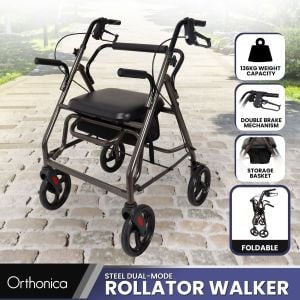
| 4 wheel with padded seat | 4 x 6 inch | Steel | 86 to 96cm | 54.5cm | 136kg | Storage basket, backrest |
| 8 inch all-terrain (black or red) | 4 x 8 inch | Steel | 86 to 104cm | 53 to 61cm | 136kg | Bag, reflective strips, adjustable seat |
| 8 inch with basket (blue or red) | 4 x 8 inch | Steel, 8.9kg | 88 to 97cm | 51 to 56cm | 136kg | Basket, cup holder, cane holder |
| Steel 4 wheel | 4 x 6 inch | Steel | 77 to 87.5cm | See product page | See product page | Built-in storage |
| Lightweight aluminium | 20cm | Aluminium | 80 to 93cm | See product page | 136kg | Cane box |
| 2-in-1 rollator wheelchair | 4 x 20cm | Aluminium, 8.9kg | 84 to 97cm | See product page | 136kg | Footrest, seat bag, converts for carer pushing |
Mostly indoors
Smaller wheels and a narrower frame can be easier around the home. Measure your doors and compare the listed width.
Footpaths and shopping
Larger 8 inch wheels roll more easily over cracks and uneven paths, and a basket or bag keeps your hands free.
Tall or short users
The lowest handle range starts at 77cm on the steel 4 wheel, and the highest reaches 104cm on the all-terrain model.
How to set up a rollator
- Handle height. Stand up straight in your usual shoes with your arms relaxed. The handles should sit about level with your wrist, with a slight bend in the elbow.
- Posture. Walk inside the frame rather than pushing it far in front, and avoid hunching over the handles.
- Seat height. When seated, your feet should rest flat on the floor. Check that the seat is wide enough and the load rating is above your weight.
Before you sit down: lock both brakes, make sure the rollator is on level ground, and back up until you feel the seat behind you. Never let someone push you while you sit on a rollator. Only a 2-in-1 is designed for that, and only in its chair mode.
Funding: NDIS and Support at Home
Rollators are classed as assistive technology. NDIS participants may be able to use plan funding for one, and older Australians on Support at Home may be eligible through the Assistive Technology and Home Modifications (AT-HM) scheme. Rules depend on your plan and how your funding is managed, so check with your plan manager or care partner before you buy.
Common questions
What is a rollator?
A rollator is a wheeled walker with hand brakes. Most also have a seat and storage. You push it as you walk, so it allows a more natural pace than a walking frame.
Is a rollator or walker better for seniors?
There is no single answer. A rollator needs enough balance and grip to use the hand brakes, while a frame is lifted with each step. A physiotherapist or OT can advise which suits the person.
Is a 3 wheel walker as stable as a 4 wheel walker?
Generally no. A 3 wheel walker is easier to steer in tight spaces, while a 4 wheel model has a wider, more stable base. An OT or physio can advise which suits you.
What size wheels are best for outdoors?
Larger wheels generally cope better with cracks, gravel and rough paths. Our all-terrain and basket models have 8 inch wheels, compared with 6 inch wheels on the smaller 4 wheel models.
What is the lightest rollator?
Our 3 wheel folding rollator is listed at 6.3kg. The 8 inch basket model and 2-in-1 are both listed at 8.9kg.
What is the weight limit on a rollator?
Most of our rollators are rated to 136kg. The 3 wheel folding model is rated to 100kg. Check the product page for each model's listed capacity.
Do rollators fold for the car?
Yes. All of our rollators fold. The 3 wheel model folds to 59 x 33 x 78cm, and on the 8 inch basket model you can also remove the leg tubes and backrest.
Can I sit on a rollator while someone pushes me?
No. A rollator seat is for resting with the brakes on. If someone needs to push you, use a wheelchair or our 2-in-1 rollator wheelchair in chair mode.
Can I buy a rollator with NDIS or Support at Home funding?
It may be possible. Rollators are classed as assistive technology. NDIS participants may be able to buy one with plan funding, and older Australians on Support at Home may be eligible through the Assistive Technology and Home Modifications (AT-HM) scheme. Eligibility depends on your plan, so check with your plan manager or care partner first.
Specifications come from each product listing, so check the product page before you buy. Funding and road rules can change, so confirm them with the relevant authority.