




Walkers and Walking Aids: Forearm Walkers and Crutches
This range includes a folding forearm support walker and a height adjustable underarm crutch. Looking for wheels, brakes and a seat? See our rollators.
Jump to: Which walking aid? · Setting the right height · FAQs
-
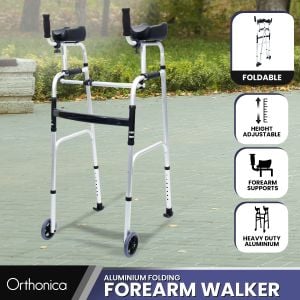
Orthonica Aluminium Forearm Support Walker Foldable Height Adjustable Mobility Aid Frame with WheelsSpecial Price $89 Regular Price $105


This guide covers product features only. For advice about your health or which type of aid suits you, talk to your doctor, occupational therapist (OT) or physiotherapist.
Which walking aid is right for you?
Forearm support walker
The Orthonica forearm walker lets you rest your forearms on supports instead of holding handles. It is aluminium, has fixed front wheels for controlled movement, folds, and adjusts from 101 to 116cm.
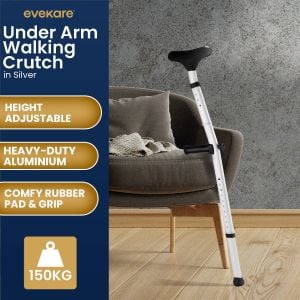
Underarm crutch
The Evekare underarm crutch is used for support when you need to take weight off a leg. It adjusts in 25mm steps from 113.8 to 151.2cm and holds up to 150kg. It is sold as a single crutch, so order two if you have been told to use a pair.
| Aid | Often suits | Keep in mind |
|---|---|---|
| Forearm walker | People who prefer to lean on their forearms rather than hold handles | Check its 60 x 52cm footprint against your doorways |
| Underarm crutches | Short-term injury or surgery recovery, usually with physio guidance | They need upper body strength and good balance |
| Rollator | People who walk further and want a seat and brakes | You need to be able to use the hand brakes |
| Knee scooter | Below-knee injuries when you cannot put weight on the foot | You need a stable good leg and a usable knee |
How to set the right height
Underarm crutches
- Stand up straight in your usual shoes. Leave a gap of two to three finger widths between the top pad and your armpit.
- Set the hand grip so your elbow bends slightly when you hold it.
- Take your weight through your hands, and do not lean on the top pad with your armpits.
Forearm walker
- Stand inside the frame with your shoulders relaxed, then set the height so your forearms rest comfortably on the supports without you hunching or lifting your shoulders.
- Take short steps and stay close to the frame, and look ahead instead of at your feet.
Ask for a fitting if you can. If you are recovering from surgery or a fall, a physiotherapist can set the height and teach you how to walk with your aid, including how to manage stairs.
Funding: NDIS and Support at Home
Walkers and crutches are classed as assistive technology. NDIS participants may be able to use plan funding for one, and older Australians on Support at Home may be eligible through the Assistive Technology and Home Modifications (AT-HM) scheme. Rules depend on your plan and how your funding is managed, so check with your plan manager or care partner before you buy.
Common questions
What is a forearm walker used for?
A forearm walker has forearm supports instead of hand grips, so you lean on your forearms rather than hold handles. An OT or physio can advise whether one suits you.
What is the difference between a walker and a rollator?
Walker is the broad term. A rollator is a type of walker with wheels, hand brakes and usually a seat. Our forearm walker has fixed front wheels and forearm supports, without a seat.
How tall can I be to use your forearm walker?
It adjusts from 101 to 116cm, so compare that range with the height of your forearms when standing with relaxed shoulders. Height alone is not a reliable guide, because arm length varies.
Are your crutches sold as a pair?
The Evekare underarm crutch is sold as a single crutch. Order two if you have been told to use a pair.
What is the weight limit on your crutch?
It is rated to 150kg (330lb).
How should underarm crutches fit?
Leave two to three finger widths below the armpit and keep a slight bend in your elbow when you hold the grip. Support your weight through your hands, not your armpits.
Should I use crutches or a knee scooter?
They work differently. Crutches take your weight through your arms, while a knee scooter rolls along with your lower leg on a pad. A knee scooter cannot be used on stairs. Ask your surgeon or physio which is right for you.
Can I buy a walker or crutch with NDIS or Support at Home funding?
It may be possible. Walkers and crutches are classed as assistive technology. NDIS participants may be able to buy one with plan funding, and older Australians on Support at Home may be eligible through the Assistive Technology and Home Modifications (AT-HM) scheme. Eligibility depends on your plan, so check with your plan manager or care partner first.
Specifications come from each product listing, so check the product page before you buy. Funding and road rules can change, so confirm them with the relevant authority.