




Mobility Scooters: Folding and Full-Size Electric Scooters
Keep getting to the shops, the park and a friend's place. Our Orthonica Journey Master electric mobility scooters include folding and full-size models, with ranges of up to 25km per charge and maximum loads of up to 180kg.
Jump to: Compare models · How to choose · Licence and road rules · FAQs

This guide covers product features only. For advice about your health or which type of aid suits you, talk to your doctor, occupational therapist (OT) or physiotherapist.
Compare our mobility scooters
| Model | Motor and top speed | Range per charge | Tyres | Scooter weight | Max load | Transport |
|---|---|---|---|---|---|---|
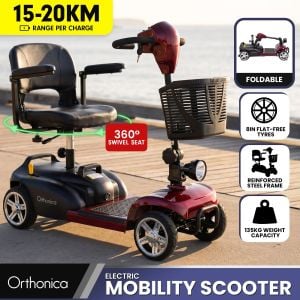
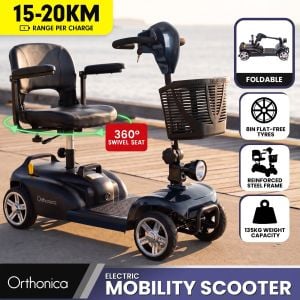
| Journey Master (blue or red) | 250W, 8km/h | 15 to 20km | 8 inch flat free | 41kg | 135kg | Seat, basket and battery lift off. Blue listing: folds to 105 x 50 x 51cm |
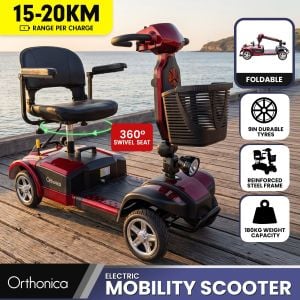
| Journey Master Plus | 350W, 10km/h | 15 to 20km | 9 inch solid | 47kg | 180kg | Folds to 120 x 50 x 54cm, seat and basket lift off |
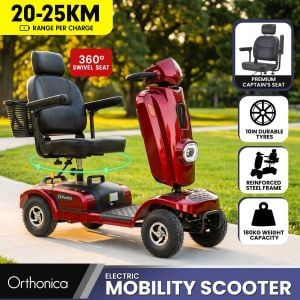
| Journey Master Elite | 400W, 10km/h | 20 to 25km | 10 inch pneumatic | 63.5kg | 180kg | Seat, basket and battery lift off |
Journey Master
The smallest and lightest of the range. Good for local trips and for storing in a smaller space, with flat free tyres that never need air.
Journey Master Plus
A higher 180kg maximum load and a stronger motor, built with heavier riders in mind, and it still folds down for transport.
Journey Master Elite
The most cushioned option, with a high back captain's seat and headrest, air-filled tyres for a softer ride and the longest range.
How to choose a mobility scooter
- Range. Think about your longest regular trip and allow plenty of margin. Rider weight, hills, rough paths and an ageing battery can all reduce how far you get.
- Rider weight. Count yourself plus whatever you carry. Choose the Plus or Elite if you are near the 135kg limit of the Journey Master.
- Tyres. Solid and flat free tyres mean no punctures. Air-filled tyres usually feel softer on uneven paths, but they can puncture and need checking.
- Getting on and off. Every model has a swivel seat and flip up armrests, so you can turn side-on to get on and off.
- Storage and charging. Plan a dry, secure spot near a power point. The Journey Master and Elite batteries lift out, so you can charge them indoors.
Will it fit in my car?
Check the folded size against your boot opening and be realistic about lifting. Even with parts removed, these scooters are heavy, and all use lead acid batteries. If nobody at home can lift it safely, it may be better to keep the scooter for trips from your front door.
Do you need a licence for a mobility scooter in Australia?
In most cases no, but the rules are set by each state and territory.
- Speed. The usual limit for a mobility device is 10km/h on level ground. Our scooters have top speeds of 8 to 10km/h.
- You count as a pedestrian. Use footpaths where you can and follow pedestrian rules at crossings.
- Roads. In Queensland, you use the road only if the footpath or nature strip is unsuitable, keeping as close as possible to the edge. Other states have similar rules.
- Weight. In Victoria, a device can weigh no more than 110kg without a rider. Our heaviest scooter is 63.5kg.
- Registration. This differs by state. Queensland has a registration process for these devices, so check with your state transport department before you ride.
First ride tip: take someone with you and practise in a quiet place. Learn how the scooter brakes and handles on different surfaces, and remember shopping bags and wet paths can change how it behaves.
Funding: NDIS and Support at Home
Mobility scooters are classed as assistive technology. NDIS participants may be able to use plan funding for one, and older Australians on Support at Home may be eligible through the Assistive Technology and Home Modifications (AT-HM) scheme. Rules depend on your plan and how your funding is managed, so check with your plan manager or care partner before you buy.
Common questions
Do I need a licence to ride a mobility scooter?
Generally no. In most states you do not need a driver's licence, but you must be able to operate it safely, and some states have registration or eligibility rules. Check with your state transport department.
How fast do your mobility scooters go?
The Journey Master has a top speed of 8km/h. The Journey Master Plus and Elite reach 10km/h, the usual limit for mobility devices in Australia.
How far will a mobility scooter go on one charge?
The Journey Master and Plus are listed at 15 to 20km, and the Elite at 20 to 25km. Real range depends on rider weight, hills, surfaces and battery age, so plan trips well inside those numbers.
What is the weight limit?
The Journey Master carries up to 135kg. The Journey Master Plus and Elite both carry up to 180kg.
Can a mobility scooter fit in a car boot?
The blue Journey Master folds to 105 x 50 x 51cm and the Plus to 120 x 50 x 54cm, with parts that lift off. They weigh 41kg and 47kg in full, so measure your boot and plan how you will lift them.
What happens if the battery goes flat?
Each model has a freewheel lever or manual mode so it can be pushed by hand. Check the battery gauge before you leave and charge it regularly as the manual directs.
Can I ride a mobility scooter on the road?
Use footpaths and nature strips wherever possible. Road use is only allowed in limited situations and the rules differ by state. Treat busy roads as off limits unless your state's rules clearly allow it.
Can I take my mobility scooter on a plane?
Ask the airline well before you book. These scooters use lead acid batteries, and each airline sets its own rules for mobility devices and batteries.
Mobility scooter or electric wheelchair?
A scooter steers with a tiller and suits people with good upper body control and sitting balance, mostly for outdoor trips. An electric wheelchair uses a joystick and usually turns more tightly, which suits indoor use.
Can I buy a mobility scooter with NDIS or Support at Home funding?
It may be possible. Mobility scooters are classed as assistive technology. NDIS participants may be able to buy one with plan funding, and older Australians on Support at Home may be eligible through the Assistive Technology and Home Modifications (AT-HM) scheme. Eligibility depends on your plan, so check with your plan manager or care partner first.
Specifications come from each product listing, so check the product page before you buy. Funding and road rules can change, so confirm them with the relevant authority.