




Knee Scooters: Foldable Steerable Knee Walkers
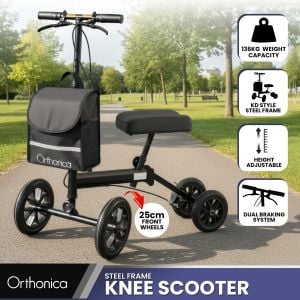
Recovering from a foot or ankle injury or surgery? A knee scooter, also called a knee walker or knee roller, lets you get around with your lower leg resting on a padded platform. Both of our foldable steerable models have dual brakes, a storage bag and a 136kg maximum load.
Jump to: Compare models · Knee scooter vs crutches · How to fit one · FAQs


This guide covers product features only. For advice about your health or which type of aid suits you, talk to your doctor, occupational therapist (OT) or physiotherapist.
Compare our knee scooters
| Feature | Dual-tube knee scooter | KD frame knee walker |
|---|---|---|
| Frame | Dual-tube welded steel | Steel, breaks down quickly for travel |
| Wheels | 10 inch | 10 inch front, 8 inch rear, PU |
| Handle height | 87 to 107.5cm | 84 to 96.5cm |
| Knee pad | PVC foam, height adjustable | Sponge and PU, 45.5 to 54.5cm high |
| Size (L x W) | 80 x 40cm | 84 x 43cm |
| Max load | 136kg | 136kg |
| Included | Bag, user manual | Bag, user manual |
Quick guide: taller users may prefer the higher 107.5cm handle reach of the dual-tube scooter. If you need to pack it down regularly for the car or travel, the KD frame is designed for that.
Knee scooter vs crutches
| Knee scooter | Crutches | |
|---|---|---|
| Effort | Roll along with your good leg | Your arms and shoulders carry your weight |
| Standing still | Rest your leg on the pad with the brakes on | You have to keep balancing on the crutches |
| Carrying things | Basket or bag | Very limited |
| Stairs | No, plan for this | Yes, once taught |
| Tight or rough ground | Can be harder | More adaptable |
Many people keep a pair of crutches for stairs and use the scooter everywhere else. Ask your surgeon or physio when you can start and whether a knee scooter is right for you.
Who is a knee scooter for?
- Ask your doctor first: people usually look at a knee scooter after being told not to put weight on a foot or ankle. Your surgeon, doctor or physio can tell you whether one suits your situation and when you can start.
- Knee problems: you rest your weight on the knee of the affected leg, so tell your specialist if that knee is injured or has had surgery.
- You'll need: a strong good leg, reasonable balance and enough hand strength to steer and brake. Your doctor can advise if you are concerned about this.
How to fit and use a knee scooter
- Knee pad. Stand on your good leg in your usual shoe, then rest your injured leg on the pad with your knee bent. Set the pad so your hips stay level and your foot is clear of the ground.
- Handles. Set the handlebars so your elbow is slightly bent and you're not hunching forward.
- Practise first. Learn the brakes indoors and take your first turns slowly. Avoid wet surfaces, gravel, steep slopes and kerbs.
- At home. Clear rugs and tight corners. If steps are a problem, a small ramp may help, or set up your main living space on one level.
Funding: NDIS and Support at Home
Knee scooters are classed as assistive technology. NDIS participants may be able to use plan funding for one, and older Australians on Support at Home may be eligible through the Assistive Technology and Home Modifications (AT-HM) scheme. Rules depend on your plan and how your funding is managed, so check with your plan manager or care partner before you buy.
Common questions
What is a knee scooter?
A knee scooter, also called a knee walker, knee roller, ankle scooter or foot scooter, is a wheeled, steerable frame with a padded platform. You rest the lower part of your injured leg on the pad and push along with your good foot.
Is a knee scooter better than crutches?
It depends on your situation. A knee scooter rolls along and has a bag for your things, but it cannot manage stairs and needs a stable good leg. Crutches can be used on stairs once you are taught how. Many people use both, so ask your surgeon or physio.
Can I use a knee scooter after knee surgery?
Ask your specialist. The knee of the affected leg takes your weight on the pad, so this is a question for the person treating you.
How tall do I need to be to use a knee scooter?
Compare handle and pad heights with your measurements. Handle height is 87 to 107.5cm on the dual-tube scooter and 84 to 96.5cm on the KD frame, whose knee pad adjusts from 45.5 to 54.5cm.
What is the weight limit?
Both models are rated to 136kg (300lb).
Do your knee scooters fold for the car?
Yes. The dual-tube scooter's handle folds down, and the KD frame breaks down quickly for travel and storage.
Is it better to hire or buy a knee scooter?
It depends on how long you need it and the cost of hire in your area. If your recovery will take many weeks, or you want a scooter straight away with no return to arrange, buying can be simpler. Compare both for your expected recovery time.
Do knee scooters have a seat?
Ours have a knee pad, not a seat. You rest your shin and knee on the pad and stand on your good leg. If you need to sit, look at a rollator or a wheelchair.
Can I use a knee scooter on stairs?
No. Plan another way to manage stairs, such as crutches with training from your physio, and ask someone to carry the scooter for you.
Can I buy a knee scooter with NDIS or Support at Home funding?
It may be possible. Knee scooters are classed as assistive technology. NDIS participants may be able to buy one with plan funding, and older Australians on Support at Home may be eligible through the Assistive Technology and Home Modifications (AT-HM) scheme. Eligibility depends on your plan, so check with your plan manager or care partner first.
Specifications come from each product listing, so check the product page before you buy. Funding and road rules can change, so confirm them with the relevant authority.