




Wheelchairs: Folding Manual and Electric Wheelchairs
Choose from lightweight folding manual wheelchairs, foldable electric wheelchairs with joystick control, and a 2-in-1 rollator wheelchair. Our guide below covers the main differences and how to measure for the right fit.
Jump to: Types · Compare models · Sizing guide · FAQs
-
Orthonica 20-Inch Self Propelled Foldable Wheelchair Lightweight 13kg Portable Steel Frame Mobility AidSpecial Price $169 Regular Price $199
-
Orthonica 2in1 Foldable Rollator Wheelchair Lightweight Aluminium Walker Transit Chair with Seat & BackrestSpecial Price $194 Regular Price $259


This guide covers product features only. For advice about your health or which type of aid suits you, talk to your doctor, occupational therapist (OT) or physiotherapist.
Which type of wheelchair do you need?
Self propelled
Large rear wheels with handrims let the user push themselves, and a carer can push too. Choose the 13kg 20 inch folding wheelchair for easier lifting, or a 24 inch model for easier self propelling, such as our self propelled steel wheelchair with swing-away footrests or 24 inch wheelchair with height adjustable footrests and a tipping bar.
Electric
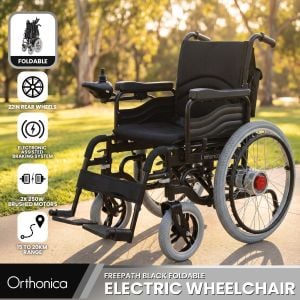
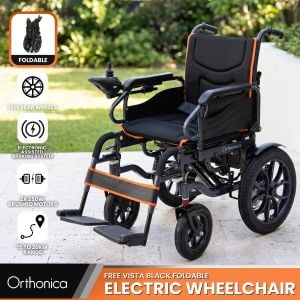
Motors and a joystick suit people who lack the strength to self propel. The FreePath has large 22 inch rear wheels and a top speed of 8km/h. The Free Vista has four-wheel suspension and a top speed of 6km/h.
2-in-1 rollator wheelchair
The Orthonica 2-in-1 is a walker when you want to walk, and flips into a chair a carer can push when you get tired. It has small wheels, so it is not designed for self propelling.
Compare our wheelchairs
| Model | Type | Weight | Max load | Seat (W x D) | Open width | Folded size (L x W x H) |
|---|---|---|---|---|---|---|
| 20 inch folding | Self propelled | 13kg | 100kg | See product page | 62cm | 74 x 20 x 68cm |
| 24 inch self propelled | Self propelled | 16.2kg | 100kg | 46 x 43cm | 61cm | 77.5 x 27.5 x 74cm |
| 24 inch with tipping bar | Self propelled | See product page | 100kg | 46cm wide | 61cm | 81 x 26 x 80cm (packed) |
| 2-in-1 rollator wheelchair | Walker and carer pushed | 8.9kg | 136kg | See product page | 62cm | 88 x 23.5 x 85cm |
| FreePath electric | Electric, 15 to 20km range | 40kg | 150kg | 44 x 50cm | 65cm | 84 x 40 x 70cm |
| Free Vista electric | Electric, 15 to 20km range | 46kg | 150kg | 44 x 50cm | 65cm | 82 x 40 x 71cm |
Heavier user? Our manual wheelchairs are rated to 100kg. For users above that, compare the 136kg 2-in-1 and the 150kg electric wheelchairs.
How to measure for a wheelchair
Measure the user while they sit on a firm chair. Getting the size right matters for comfort and fit.
- Seat width. Measure across the widest part of the hips or thighs and allow a little extra, roughly 2.5cm each side, plus room for bulky clothing.
- Seat depth. Measure from the back of the hips to the back of the knee, then take off about 3 to 5cm. A seat that is too deep can press behind the knees.
- Doorways. Add a little clearance to the chair's open width, and check for tight turns in hallways and bathrooms.
- Weight limit. Choose a maximum load above the user's weight.
If someone will spend most of the day in a wheelchair, or has a health condition to consider, ask an occupational therapist to assess them before you buy.
Getting over steps and into the car
Wheelchair users often need a ramp for steps and kerbs. For the car, a lighter frame is much easier to lift. Our electric chairs fold down too, but at 40kg or more they are usually a two-person lift or need a vehicle ramp.
Funding: NDIS and Support at Home
Wheelchairs are classed as assistive technology. NDIS participants may be able to use plan funding for one, and older Australians on Support at Home may be eligible through the Assistive Technology and Home Modifications (AT-HM) scheme. Rules depend on your plan and how your funding is managed, so check with your plan manager or care partner before you buy.
Common questions
What is the difference between a self propelled and a transit wheelchair?
A self propelled wheelchair has large rear wheels with handrims, so the user can push themselves. A transit wheelchair has smaller rear wheels and is pushed by a carer. Transit chairs are usually lighter and more compact, while large wheels roll more easily over rough ground.
How do I measure wheelchair seat width?
Measure the widest part of the hips or thighs while seated, then add around 2.5cm on each side. Our listed seat widths range from 44cm on the electric chairs to 46cm on the 24 inch manual chairs.
What is your lightest wheelchair?
The 2-in-1 rollator wheelchair is listed at 8.9kg. Of the self propelled models, the 20 inch folding wheelchair is lightest at 13kg, followed by the 24 inch self propelled model at 16.2kg.
Do your wheelchairs fit in a car boot?
The manual chairs are listed as fitting most car boots, and the 20 inch model folds to just 20cm wide. The electric chairs also fold to fit a boot, but they weigh 40kg or more, so check your boot opening and who will be lifting.
How far can an electric wheelchair travel on one charge?
Both models are listed at 15 to 20km per charge on a 24V 12Ah lead acid battery. Actual range depends on user weight, hills and surfaces.
Can an electric wheelchair be pushed by hand?
Yes. Both can be pushed when the power is off. The FreePath has a manual mode for a flat battery and the Free Vista has push handles for a carer.
Can electric wheelchairs handle hills?
The FreePath is listed for climbs up to 12 degrees and holds on slopes. The Free Vista has a hill-hold parking function and anti-tip wheels. Take care on any slope, and check the manual for safe limits.
Can I take an electric wheelchair on a plane?
Contact the airline well before you travel. Both of our electric chairs use lead acid batteries, and each airline sets its own rules for mobility devices and batteries.
Do I need a licence for an electric wheelchair?
Generally no. Motorised wheelchair users are usually treated as pedestrians with a 10km/h limit, but some states have registration or other requirements, so check with your state transport department.
Can I buy a wheelchair with NDIS or Support at Home funding?
It may be possible. Wheelchairs are classed as assistive technology. NDIS participants may be able to buy one with plan funding, and older Australians on Support at Home may be eligible through the Assistive Technology and Home Modifications (AT-HM) scheme. Eligibility depends on your plan, so check with your plan manager or care partner first.
Specifications come from each product listing, so check the product page before you buy. Funding and road rules can change, so confirm them with the relevant authority.